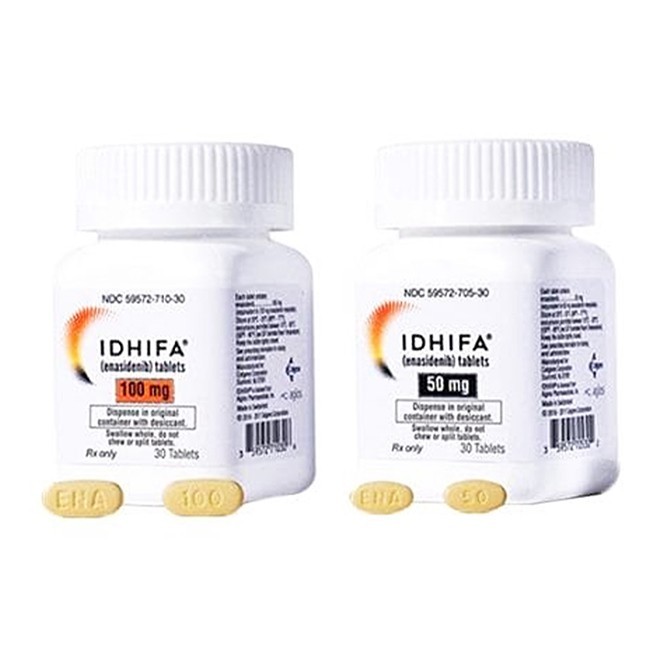


As an isocitrate dehydrogenase-2 (IDH2) inhibitor, Enasidenib offers a targeted treatment option for patients with relapsed or refractory acute myeloid leukemia (AML). Its unique mechanism of action targets IDH2 mutations. In clinical application, it is essential to strictly adhere to dosage specifications and adjust the treatment plan according to the patient's specific conditions.
Dosage and Administration, Recommended Dose of Enasidenib
Recommended Dose and Administration Method
The standard administration regimen of Enasidenib is 100 mg orally once daily, and treatment should continue until disease progression or unacceptable toxic reactions occur.
Based on clinical study data, to achieve a sufficient clinical response, it is recommended to continue medication for at least 6 months.
The tablets should be swallowed whole; chewing, splitting, or crushing is not allowed.
It is advisable to take the medication at a fixed time every day. Food does not affect drug absorption, so administration on an empty stomach or after meals is acceptable.
If vomiting occurs after dosing or a dose is missed, the missed dose should be taken as soon as possible on the same day, and the normal dosing schedule should be resumed the next day. Double dosing to make up for a missed dose is prohibited.
If it is necessary to adjust the dosing time, an interval of at least 12 hours from the last dose must be ensured.
Dose Adjustment of Enasidenib
Differentiation Syndrome
It can occur as early as within 1 day of drug administration.
Once suspected, corticosteroid therapy and hemodynamic monitoring must be initiated immediately.
In case of severe pulmonary symptoms requiring tracheal intubation or persistent renal dysfunction for more than 48 hours, Enasidenib should be suspended. Medication can be resumed when symptoms resolve to grade 2 or lower.
Tumor Lysis Syndrome
Before treatment and in the early stage of medication, monitor blood routine and blood biochemistry at least every 2 weeks to promptly detect electrolyte disturbances or renal dysfunction.
If grade 3 or higher toxic reactions occur, medication should be suspended until the condition recovers to ≤ grade 2. Subsequently, resume treatment at a reduced dose of 50 mg once daily. Permanent discontinuation is required if the toxic reaction recurs.
Medication in Special Populations of Enasidenib
Patients with Hepatic or Renal Impairment
Patients with mild to moderate hepatic impairment do not require dose adjustment.
The standard dose regimen is applicable to patients with the following conditions: total bilirubin ≤ upper limit of normal (ULN) and aspartate aminotransferase (AST) > ULN, or total bilirubin 1–1.5 times the ULN; as well as patients with moderate to severe renal impairment (creatinine clearance ≥ 30 mL/min).
Reproductive-Age Patients
Based on animal experimental evidence, Enasidenib has embryo-fetal toxicity.
All women of reproductive age must undergo pregnancy verification before initiating treatment, and adopt effective non-hormonal contraceptive measures during treatment and within 2 months after the last dose.
This drug may reduce the efficacy of hormonal contraceptives, so the combined use of barrier contraception is recommended.
Sexual partners of male patients should also adopt effective contraception during the same period.
Lactating Women
Currently, there are no data available on the distribution of Enasidenib in breast milk.
Considering the potential risks to infants, it is recommended to discontinue breastfeeding during treatment and within 2 months after stopping the drug.