

Enasidenib is a targeted medication for the treatment of relapsed or refractory acute myeloid leukemia (AML). Its rational use is of crucial importance to patients. Due to the specific nature of this drug, how to obtain it safely and in a standardized manner, as well as effectively identify genuine versus counterfeit products, has become a key concern for patients and their family members.
Procurement Channels for Enasidenib
Overseas Procurement
Patients may choose to consult and purchase Enasidenib at hospital pharmacies or licensed drugstores in countries or regions where the drug has been launched.
Since drug prices may be affected by factors such as regional differences and exchange rate fluctuations, patients need to make adequate budgeting and planning before purchasing.
Procurement via Medical Service Institutions
Patients may consult domestic overseas medical service organizations that cooperate with international pharmacies or pharmaceutical companies.
These institutions typically provide legal import channels and offer professional consultation and guidance.
Precautions for Enasidenib Procurement and Use
Strict Compliance with Clinical Indications
Enasidenib is only indicated for adult patients with relapsed or refractory AML who harbor an IDH2 mutation.
Before initiating treatment, the mutation status must be confirmed using an FDA-approved detection method to avoid ineffective therapy.
Pre-Treatment Risk Assessment
Prevention of Differentiation Syndrome: According to the drug label warning, this syndrome may occur within 1 day to 5 months after starting the medication, presenting with symptoms such as fever, dyspnea, and bone pain. A response plan must be developed in advance.
Prevention of Embryofetal Toxicity: Patients of reproductive potential must undergo a pregnancy test before starting treatment, and use effective non-hormonal contraceptive measures during treatment and for 2 months after discontinuing the drug.
Management of Drug Interactions
Concomitant use of drugs that are substrates of CYP1A2, CYP2C19, or CYP3A (e.g., certain antifungal agents) should be avoided.
Concomitant use of substrates of OATP1B1/BCRP (e.g., rosuvastatin) should be avoided.
The frequency of caffeine intake needs to be adjusted (as inhibition of CYP1A2 may lead to enhanced caffeine effects).
Treatment Course and Dosage Adjustment
The standard dosage is 100 mg taken orally once daily, and treatment should be continued until disease progression or the development of intolerable toxicity.
If no disease deterioration occurs, it is recommended to continue the medication for at least 6 consecutive months to monitor the clinical response.
In case of vomiting or a missed dose, the missed dose should be taken on the same day, and the regular dose should be administered as usual on the following day.
Authentication of Genuine Enasidenib (Genuine vs. Counterfeit)
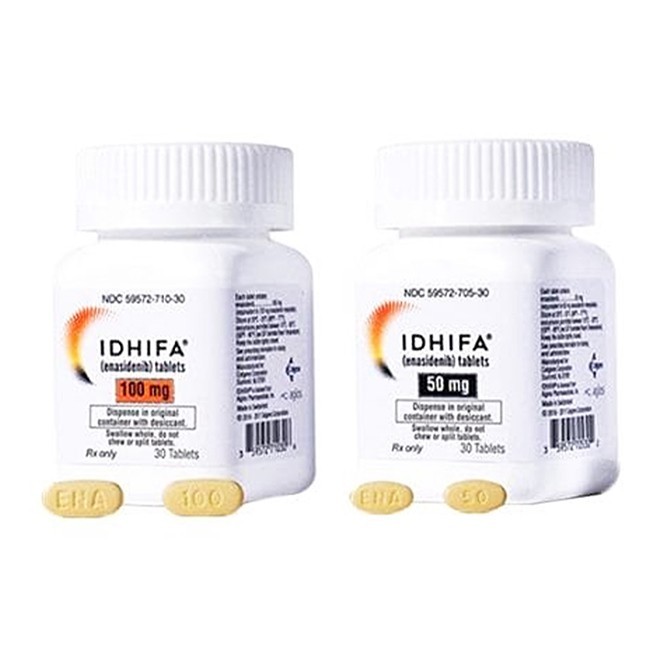
Verification of Packaging Markings
Strength Correspondence:
50 mg tablets: Yellowish-white, oval-shaped, film-coated tablets engraved with "ENA50".
100 mg tablets: Yellowish-white, capsule-shaped, film-coated tablets engraved with "ENA100".
Packaging Integrity: The original bottle should be equipped with a desiccant container, and the bottle cap should be properly sealed. If the bottle body is damaged or the desiccant changes color, the product should be highly suspected of being counterfeit.
Comparison of Tablet Characteristics
50 mg tablets: Yellowish-white and oval-shaped, engraved with "ENA" and "50".
100 mg tablets: Yellowish-white and capsule-shaped, engraved with "ENA" and "100".
The tablets should have a uniform texture without cracks, with clear engravings and sharp edges.