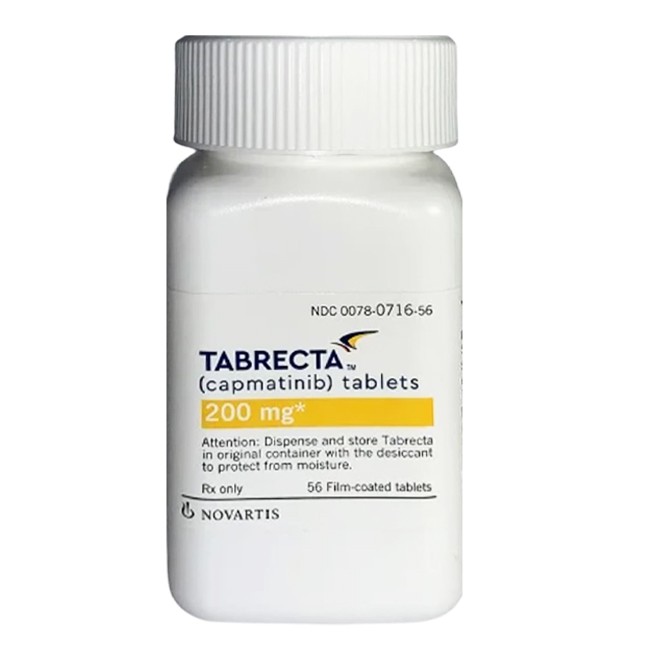


Capmatinib (Tabrecta) is a highly selective MET inhibitor, offering a precision treatment option for patients with metastatic non-small cell lung cancer (NSCLC) harboring MET exon 14 skipping mutations.
Dosage and Administration, Recommended Dosage of Capmatinib (Tabrecta)
Recommended Dosage and Administration Method
The standard treatment regimen for capmatinib is 400 mg orally twice daily, with administration independent of food intake.
Special attention should be paid to swallowing the tablets whole; splitting, crushing, or chewing is strictly prohibited.
If a dose is missed or vomiting occurs after administration, no additional dose is needed; resume the next scheduled dose as planned.
Patient Selection Criteria
Prior to medication initiation, the presence of mutations causing MET exon 14 skipping in tumor tissue or plasma samples must be confirmed using an FDA-approved testing method.
If plasma testing yields negative results, tumor tissue testing is recommended whenever feasible.
Dose Adjustment of Capmatinib (Tabrecta)
Dose Reduction Ladder
First dose adjustment: Reduce to 300 mg twice daily.
Second dose adjustment: Reduce to 200 mg twice daily.
If the patient is unable to tolerate the dose of 200 mg twice daily, permanent discontinuation of treatment is required.
Dose Adjustments for Specific Adverse Reactions
Interstitial lung disease/pneumonitis: Permanent discontinuation is required for adverse reactions of any grade.
Elevated liver enzymes: For Grade 3 adverse reactions, suspend medication until baseline levels are restored. Resume at the original dose if recovery occurs within 7 days; otherwise, resume at a reduced dose. Permanent discontinuation is required for Grade 4 adverse reactions.
Elevated bilirubin: For Grade 2 adverse reactions, suspend medication until baseline levels are restored and resume at the original dose if recovery occurs within 7 days. For Grade 3 adverse reactions, suspend medication until baseline levels are restored and resume at a reduced dose if recovery occurs within 7 days.
Pancreatitis: For Grade 3 adverse reactions, suspend medication until the condition improves to Grade ≤2 or baseline levels; resume at a reduced dose if recovery occurs within 14 days. Permanent discontinuation is required for Grade 4 adverse reactions.
Use in Special Populations of Capmatinib (Tabrecta)
Patients with Hepatic or Renal Impairment
No initial dose adjustment is required for patients with mild to moderate hepatic impairment or mild to moderate renal impairment (creatinine clearance ≥ 30 mL/min).
Clinical data are insufficient for patients with severe renal impairment (creatinine clearance 15–29 mL/min), necessitating individualized risk-benefit assessment.
Geriatric Patient Population
Clinical studies show that 61% of patients were aged ≥ 65 years, and 18% were aged ≥ 75 years.
No significant difference in efficacy was observed compared with younger patients, but enhanced monitoring is recommended.
Pregnancy and Lactation Management
Based on embryo-fetal toxicity observed in animal studies, capmatinib may cause fetal harm if administered to pregnant women.
Women of childbearing potential must confirm their pregnancy status prior to treatment and adopt effective contraceptive measures during treatment and for 1 week after the last dose.
Lactating women should discontinue breastfeeding.