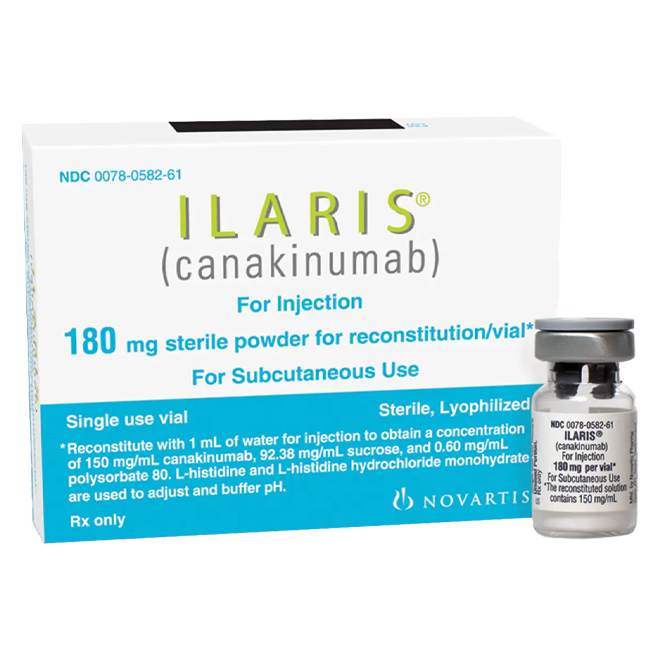


Canakinumab (Ilaris) is a fully human monoclonal antibody that neutralizes interleukin-1β (IL-1β) with high affinity and selectivity, thereby inhibiting its key role in various autoinflammatory diseases.
Dosage and Administration, Recommended Doses of Canakinumab (Ilaris)
Cryopyrin-Associated Periodic Syndromes (CAPS)
For patients with body weight > 40 kg: The recommended dose is 150 mg, administered subcutaneously once every 8 weeks.
For patients with body weight between 15 kg and 40 kg (inclusive): The recommended dose is 2 mg/kg, administered subcutaneously once every 8 weeks.
For pediatric patients with insufficient therapeutic response, the dose may be increased to 3 mg/kg.
Tumor Necrosis Factor Receptor-Associated Periodic Syndrome (TRAPS), Hyperimmunoglobulin D Syndrome/Mevalonate Kinase Deficiency (HIDS/MKD) and Familial Mediterranean Fever (FMF)
For patients with body weight > 40 kg: The initial dose is 150 mg, administered subcutaneously once every 4 weeks.
If the clinical response is inadequate, the dose may be increased to 300 mg once every 4 weeks.
For patients with body weight ≤ 40 kg: The initial dose is 2 mg/kg, administered subcutaneously once every 4 weeks.
If the clinical response is inadequate, the dose may be increased to 4 mg/kg once every 4 weeks.
Still's Disease
Indicated for adult-onset Still’s disease (AOSD) and systemic juvenile idiopathic arthritis (SJIA) patients aged 2 years and older.
For patients with body weight ≥ 7.5 kg: The recommended dose is 4 mg/kg, administered subcutaneously once every 4 weeks. The maximum single dose is 300 mg.
Gout Flares
Indicated for acute gout flares in adults who have contraindications to, are intolerant of, or have inadequate response to nonsteroidal anti-inflammatory drugs (NSAIDs) and colchicine, and who are not suitable for repeated use of corticosteroids.
The recommended dose is a single subcutaneous injection of 150 mg.
If retreatment is required, the next dose of canakinumab should be administered at an interval of at least 12 weeks.
Dose Adjustment of Canakinumab (Ilaris)
Dose Escalation Based on Efficacy
During the treatment of TRAPS, HIDS/MKD and FMF, if the clinical response to the initial dose (150 mg or 2 mg/kg once every 4 weeks) is inadequate.
The dose may be escalated (to 300 mg for adults, and to 4 mg/kg for patients ≤ 40 kg, once every 4 weeks).
For pediatric CAPS patients with body weight between 15–40 kg, if the 2 mg/kg dose yields suboptimal efficacy, the dose may be escalated to 3 mg/kg once every 8 weeks.
Treatment Suspension or Discontinuation Based on Safety
Severe infections: If a patient develops a severe infection, canakinumab treatment should be immediately suspended until the infection is controlled.
Severe hypersensitivity reactions: In case of severe hypersensitivity reactions, including drug reaction with eosinophilia and systemic symptoms (DRESS), canakinumab should be permanently discontinued immediately and appropriate treatment should be given.
Administration in Special Populations
Pregnancy
Available human data are insufficient to evaluate the risks of drug-related major birth defects, miscarriage and adverse maternal-fetal outcomes.
Since IgG antibodies can cross the placenta, especially in the third trimester of pregnancy, it may cause immunosuppression in infants. The potential benefits and risks should be fully weighed before use.
Lactation
There are no data on whether canakinumab is present in human milk or its effects on breastfed infants.
The developmental and health benefits of breastfeeding, the mother’s clinical need for canakinumab, and the potential adverse effects of the drug or the mother’s underlying disease on the infant should be taken into consideration.