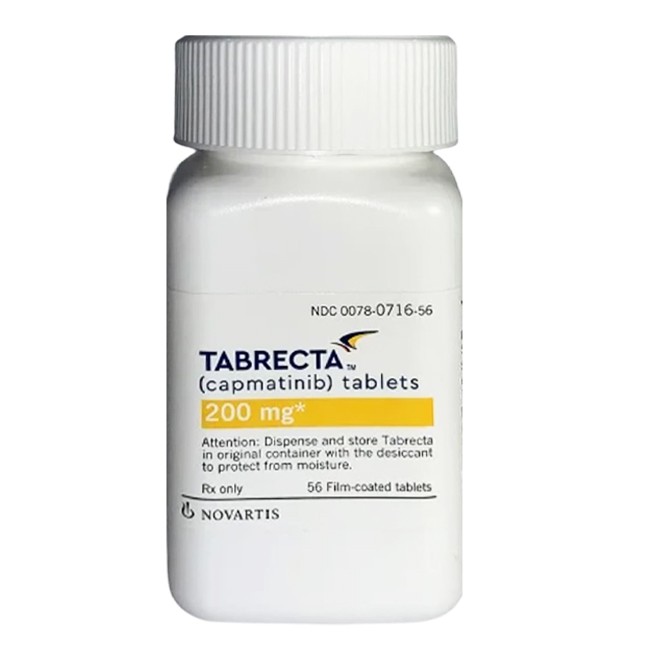


Capmatinib (Tabrecta) is a kinase inhibitor indicated for the treatment of adult patients with metastatic non-small cell lung cancer (NSCLC) harboring MET exon 14 skipping mutation.
Dosage and Administration, Recommended Dose of Capmatinib (Tabrecta)
Patient Screening Criteria
(1) Before treatment, the presence of mutations causing MET exon 14 skipping in tumor or plasma samples must be confirmed by an FDA-approved testing method.
(2) If the mutation is not detected in plasma samples, tumor tissue testing is recommended whenever possible.
Recommended Dose and Administration Method
(1) Standard dose: 400 mg orally, twice daily, which can be taken with food or on an empty stomach.
(2) Administration requirements: Swallow the tablets whole; do not break, crush, or chew them.
(3) Management of missed dose or vomiting: If a dose is missed or vomiting occurs after administration, do not take a supplementary dose and take the next dose at the originally scheduled time.
Dose Adjustment of Capmatinib (Tabrecta)
Dose Adjustment Related to Adverse Reactions
(1) First dose reduction: 300 mg orally, twice daily.
(2) Second dose reduction: 200 mg orally, twice daily.
(3) Indications for permanent discontinuation: Patients who cannot tolerate 200 mg twice daily need to terminate treatment.
Hepatotoxicity
(1) Elevation of alanine aminotransferase (ALT) or aspartate aminotransferase (AST) to Grade 3 (without concurrent bilirubin elevation): Suspend medication until the indicators return to baseline; patients who recover within 7 days may continue at the original dose, otherwise dose reduction is required.
(2) Elevation of ALT/AST to Grade 4 or accompanied by bilirubin elevation: Permanently discontinue the drug.
Pancreatic Toxicity
(1) Elevation of amylase or lipase to Grade 3: Suspend medication until levels decrease to ≤ Grade 2 or baseline; patients who recover within 14 days may continue at a reduced dose, otherwise permanent discontinuation is required.
(2) Pancreatitis (any grade): Permanently discontinue the drug.
(3) Hypersensitivity reaction: Suspected reactions require suspension of medication until symptoms resolve; severe reactions necessitate permanent discontinuation.
Use in Special Populations of Capmatinib (Tabrecta)
Patients with Hepatic Impairment
(1) No dose adjustment is required for patients with mild to moderate hepatic impairment (Child-Pugh Class A or B).
(2) Use is prohibited in patients with severe hepatic impairment (Child-Pugh Class C).
Pregnancy and Lactation
(1) Pregnancy: Animal studies have demonstrated embryo-fetal toxicity. It is recommended that women of childbearing potential use effective contraceptive measures during treatment and for 1 week after the last dose.
(2) Lactation: Breastfeeding is prohibited during treatment and for 1 week after discontinuation of the drug.
Reproductive-Age Population
(1) Women should confirm their pregnancy status before treatment and use effective contraception during treatment and for 1 week after the last dose.
(2) Men with partners of childbearing potential should also take contraceptive measures during treatment and for 1 week after stopping the drug.