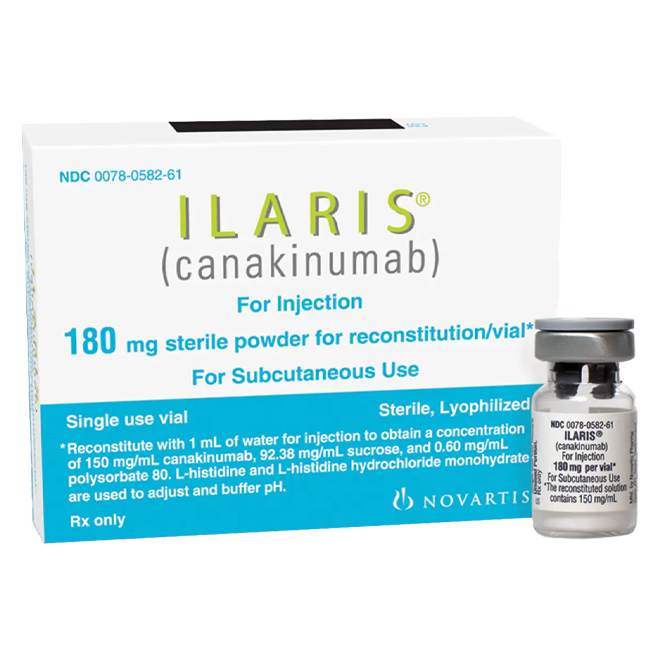


Canakinumab (Ilaris) is an interleukin-1β blocker indicated for the treatment of various autoinflammatory diseases.
Dosage and Administration, Recommended Doses of Canakinumab (Ilaris)
General Administration Method
Canakinumab is administered by subcutaneous injection; other routes of administration are prohibited.
The drug solution must be inspected before injection. Do not use it if there is significant brown discoloration, marked opalescence, or visible particles.
Scar tissue should be avoided during injection to prevent interference with drug absorption.
Cryopyrin-Associated Periodic Syndromes (CAPS)
For patients weighing more than 40 kg: 150 mg once every 8 weeks.
For patients weighing 15–40 kg: 2 mg/kg once every 8 weeks.
For pediatric patients weighing 15–40 kg with an inadequate response, the dose can be increased to 3 mg/kg.
Tumor Necrosis Factor Receptor-Associated Periodic Syndrome (TRAPS), Hyperimmunoglobulin D Syndrome/Mevalonate Kinase Deficiency (HIDS/MKD), and Familial Mediterranean Fever (FMF)
For patients weighing more than 40 kg: The initial dose is 150 mg once every 4 weeks; the dose can be increased to 300 mg if the clinical response is inadequate.
For patients weighing ≤40 kg: The initial dose is 2 mg/kg once every 4 weeks; the dose can be increased to 4 mg/kg if necessary.
Still’s Disease
Including Adult-Onset Still’s Disease (AOSD) and Systemic Juvenile Idiopathic Arthritis (SJIA): Applicable to patients with a body weight ≥7.5 kg: 4 mg/kg (maximum dose 300 mg) once every 4 weeks.
Gout Flares
The recommended dose for adult patients is 150 mg via subcutaneous injection.
If retreatment is required, the new dose should be administered at least 12 weeks after the first dose.
Dose Adjustment of Canakinumab (Ilaris)
Efficacy-Based Adjustment
For patients with TRAPS, HIDS/MKD, and FMF, the dose can be escalated if the clinical response is insufficient at the initial dose.
Dose Adjustment for Special Cases
For CAPS pediatric patients weighing 15–40 kg: The dose can be increased to 3 mg/kg in case of inadequate response.
For patients with TRAPS, HIDS/MKD, and FMF: The dose can be doubled from the initial dose as needed.
Medication Use in Special Populations for Canakinumab (Ilaris)
Vaccination Precautions
It is recommended that pediatric patients complete all recommended vaccinations before initiating canakinumab treatment.
Live virus vaccines should be avoided in infants who have been exposed to canakinumab in utero during maternal treatment or while receiving canakinumab therapy.
Geriatric Use
In clinical studies of gout flares, 17.3% of patients treated with canakinumab were aged 65 years and above, and 3.3% were aged 75 years and above.
There were no significant differences in efficacy profiles between geriatric and younger patients.
Use in Pregnancy
Available data indicate that monoclonal antibodies such as canakinumab are actively transported across the placenta, which may cause immunosuppression in infants with intrauterine exposure.
The potential benefits and risks must be weighed when using canakinumab during pregnancy, and the treating physician should be informed.
Use in Lactation
There are currently no data on whether canakinumab is present in human milk or its impact on milk production.
The developmental and health benefits of breastfeeding, as well as the mother's clinical need for canakinumab, should be comprehensively considered.