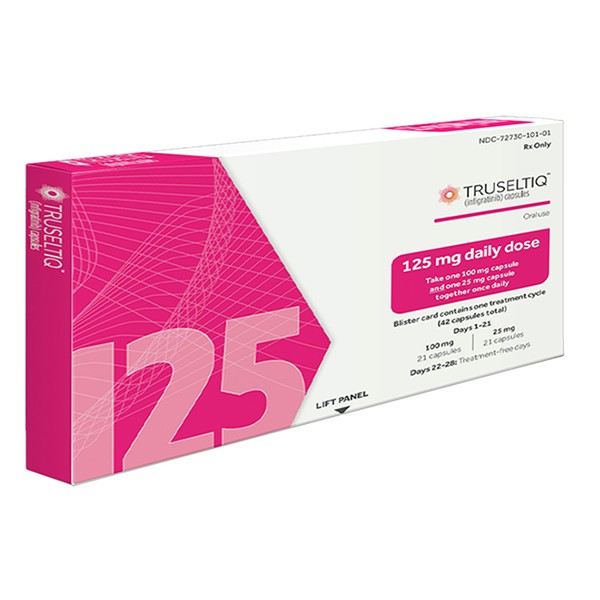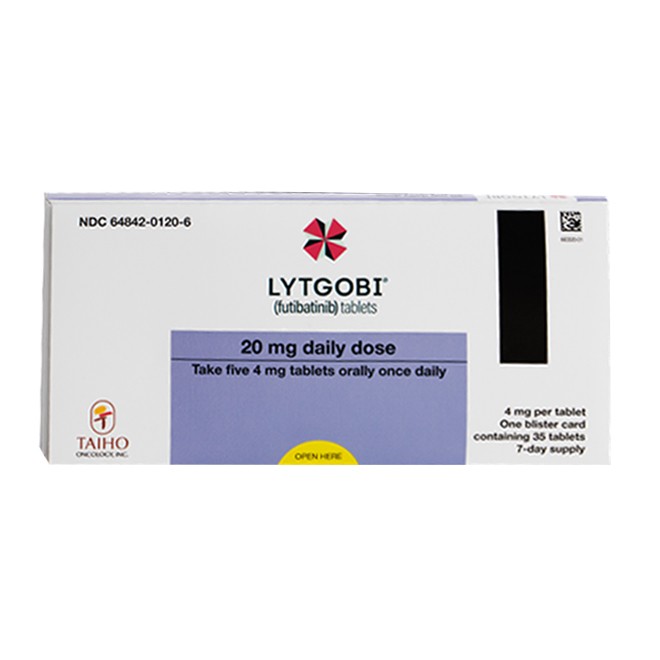


Infigratinib is an oral kinase inhibitor targeting FGFR2, indicated for patients with specific gene mutations in cholangiocarcinoma.
I. Indications
1. Infigratinib is indicated for adult patients with previously treated, unresectable locally advanced or metastatic cholangiocarcinoma.
2. Prior to use, the presence of an FGFR2 gene fusion or other rearrangement must be confirmed by an FDA-approved test.
II. Contraindications
1. No absolute contraindications:
(1) According to the prescribing information, infigratinib has no absolute contraindications.
(2) However, this does not mean all patients can safely use it; assessment should still be based on the patient's specific condition and concomitant medications.
2. Concomitant medications to avoid:
(1) Concomitant use with strong or moderate CYP3A inhibitors (e.g., itraconazole, clarithromycin) is prohibited, as they may significantly increase plasma concentrations and increase toxicity risk.
(2) Concomitant use with strong or moderate CYP3A inducers (e.g., rifampin, carbamazepine) is prohibited, as they may reduce efficacy.
(3) Avoid concomitant use with proton pump inhibitors.
III. Foods to avoid
1. Grapefruit and its products:
(1) Avoid eating grapefruit or drinking grapefruit juice during treatment.
(2) Components in grapefruit can inhibit CYP3A metabolic enzymes, potentially leading to significantly increased infigratinib plasma concentrations and increased risk of adverse reactions.
2. High-fat, high-calorie meals:
(1) Avoid taking the medication after a high-fat, high-calorie meal, as food can increase drug exposure by 80%-120%, increasing the incidence and severity of adverse reactions such as hyperphosphatemia.
(2) Take on an empty stomach (at least 1 hour before or 2 hours after a meal).
IV. Use in specific populations
1. Pregnant and breastfeeding women:
(1) Infigratinib can cause fetal harm; in animal studies, malformations, fetal growth retardation, and embryo-fetal death were observed at exposures below clinical exposure.
(2) Women of childbearing potential must have a negative pregnancy test before treatment and use effective contraception during treatment and for 1 month after the last dose.
(3) Male patients with female partners of childbearing potential should also use effective contraception during the same period.
Breastfeeding is prohibited during treatment and for 1 month after the last dose.
2. Patients with hepatic or renal impairment:
(1) For mild to moderate renal impairment (creatinine clearance 30-89 mL/min), the recommended dose is 100 mg once daily.
(2) Safety in severe renal impairment or dialysis patients has not been established.
(3) For mild hepatic impairment (total bilirubin >ULN-1.5×ULN, or AST >ULN), the recommended dose is 100 mg once daily; for moderate hepatic impairment (total bilirubin 1.5-3×ULN), the recommended dose is 75 mg once daily.
(4) Safety and dosage in severe hepatic impairment have not been established.
3. Elderly patients:
(1) In clinical studies, 33% of patients were aged ≥65 years, and 10% were ≥75 years.
(2) No overall differences in safety or efficacy were observed between elderly and younger adults; no special dose adjustment is needed.
4. Pediatric patients:
(1) Safety and efficacy have not been established.
(2) Animal studies showed skeletal toxicity in rats and dogs, and dental toxicity in rats at exposures below clinical exposure.
5. Males and females of reproductive potential:
(1) Verify that female patients of childbearing potential are not pregnant before treatment.
(2) Female patients and male patients with female partners of childbearing potential must use effective contraception during treatment and for 1 month after the last dose.