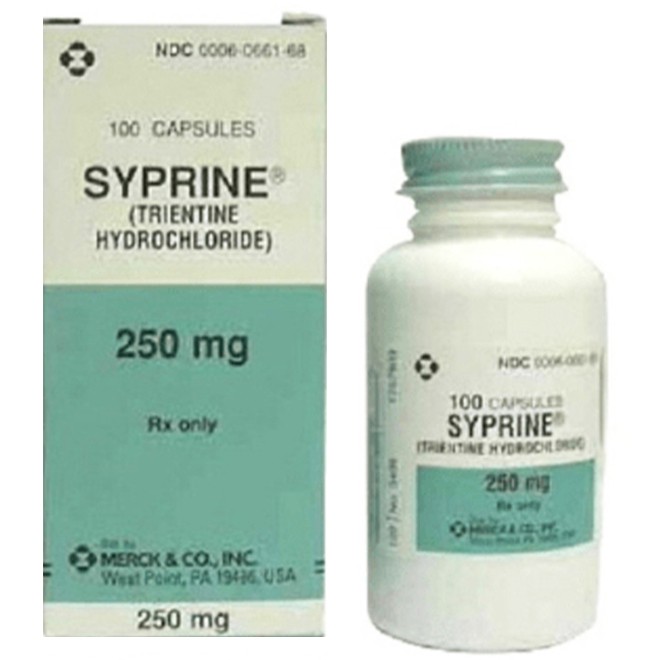


As a novel copper chelator, trientine (CUVRIOR) has specific indications, contraindications, and dosing guidelines for special populations.
I. Indications of Trientine (CUVRIOR)
1. Core Indications
(1) Trientine is indicated for adult patients with stable Wilson’s disease who have achieved decoppering and are tolerant to penicillamine.
(2) This means patients must meet all three of the following criteria:
① Confirmed diagnosis of Wilson’s disease;
② Body copper burden has been reduced to a safe range (i.e., in a “decoppered” state);
③ No severe adverse reactions occurred during prior penicillamine therapy, or treatment could not be continued due to side effects.
2. Ineligible Populations
Trientine is not suitable for the following cases:
(1) Treatment-naïve newly diagnosed Wilson’s disease patients.
(2) Patients intolerant to penicillamine who have not yet been tried on CUVRIOR (the prescribing information specifies “penicillamine-tolerant”).
(3) Pediatric patients (safety and efficacy have not been established).
(4) Critically ill patients or those with acute liver failure requiring urgent decoppering.
3. Prerequisites for Use
(1) Penicillamine must be discontinued before switching to CUVRIOR.
(2) Dosage conversion shall follow the conversion table in the prescribing information; empirical substitution is not permitted.
II. Contraindications and Contraindicated Foods of Trientine (CUVRIOR)
1. Absolute Contraindications
(1) Contraindicated in patients hypersensitive to trientine or any excipients in CUVRIOR (e.g., mannitol, silicon dioxide, etc.).
(2) If rash, pruritus, or other allergic manifestations occur after administration, immediate medical evaluation is required.
2. Contraindicated Foods and Administration Timing
(1) CUVRIOR should be administered on an empty stomach: at least 1 hour before a meal or at least 2 hours after a meal, with an interval of at least 1 hour from any food or milk.
(2) Proteins and metal ions in food may bind to the drug, significantly reducing its absorption rate.
3. Strictly Spaced Food Supplements
(1) Concomitant use with mineral supplements (iron, zinc, calcium, magnesium) should be avoided. If use is necessary:
(2) Iron preparations: allow an interval of at least 2 hours.
(3) Other mineral supplements: allow an interval of at least 1 hour.
(4) Although high-calcium and high-iron foods in the daily diet (e.g., milk, red meat, fortified cereals) are not absolutely prohibited, the drug should be taken during the fasting window between meals to avoid co-ingestion with these foods.
4. Other Oral Medications
An interval of at least 1 hour must be observed between CUVRIOR and any other oral medications to prevent chelation from affecting therapeutic efficacy.
III. Use in Special Populations for Trientine (CUVRIOR)
Use during pregnancy
(1) The lowest effective dose should be used during pregnancy, with serum copper levels monitored throughout the treatment course.
(2) The drug must not be discontinued without medical advice, as this may lead to hepatic decompensation.
Use during lactation
It is recommended to weigh the benefits of breastfeeding against potential risks under the guidance of a physician.
Use in pediatric patients
Safety and effectiveness in pediatric patients have not been established. Use in patients under 18 years of age is not recommended.
Use in elderly patients
Elderly patients generally have decreased hepatic, renal and cardiac function, and often receive multiple concomitant medications. It is recommended to initiate dosing at the lower end of the dosage range and adjust with caution.
Patients with hepatic or renal impairment
(1) The drug is primarily excreted in urine; caution should be exercised in patients with severe renal impairment.
(2) Patients with Wilson’s disease often have concomitant liver injury, and liver function should be monitored regularly during treatment.