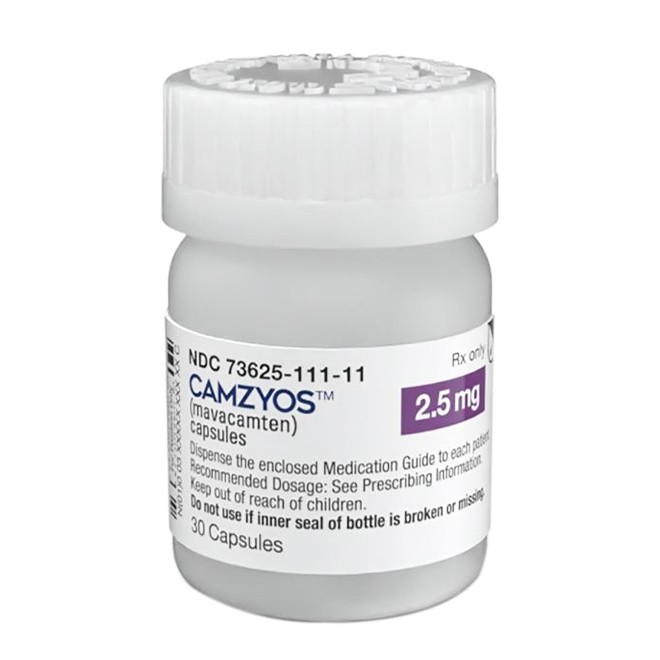


Camzyos (Mavacamten) is a cardiac myosin inhibitor approved in the United States in 2022. It is indicated for the treatment of adult patients with symptomatic obstructive hypertrophic cardiomyopathy (HCM) classified as New York Heart Association (NYHA) Functional Class II–III, to improve their functional capacity and symptoms.
Dosage and Administration of Camzyos (Mavacamten)
Initial Dose
The recommended starting dose is 5 mg, taken orally once daily, with or without food.
Initiation or dose escalation of Camzyos is not recommended in patients with a left ventricular ejection fraction (LVEF) < 55%.
Dosing Regimen
Initiation Phase: After treatment initiation, echocardiographic assessments are required at Week 4, Week 8, and Week 12. Based on a predefined algorithm, decisions are made to maintain the current dose, reduce the dose, or temporarily discontinue treatment.
Maintenance Phase: After 12 weeks of treatment, patients enter the maintenance phase, during which LVEF and symptoms are assessed periodically (e.g., every 3–6 months).
If LVEF is ≥ 55% and the Valsalva left ventricular outflow tract (LVOT) gradient remains ≥ 30 mmHg, dose escalation to the next higher level (e.g., from 5 mg to 10 mg) may be considered. Reassessment is required within 4 weeks following each dose increase.
Maximum Dose: The maximum recommended dose is 15 mg once daily.
Administration Instructions
Capsules should be swallowed whole; do not break, crush, or chew them.
If a dose is missed, take the missed dose as soon as possible on the same day. Take the next dose at the regularly scheduled time on the following day.
Do not take a double dose on the same day.
Dose Adjustment Strategies for Camzyos (Mavacamten)
Mandatory Interruption and Reinitiation Based on LVEF
Treatment Interruption: If LVEF < 50% is observed at any visit during treatment, Camzyos must be immediately interrupted.
Treatment Reinitiation: After interruption, repeat echocardiography every 4 weeks until LVEF returns to ≥ 50%. Treatment may be reinitiated at a reduced dose level (e.g., from 10 mg to 5 mg). If the dose at the time of interruption was the lowest dose of 2.5 mg, reinitiation at 2.5 mg or permanent discontinuation may be considered.
Permanent Discontinuation: If LVEF < 50% occurs twice during treatment at the daily dose of 2.5 mg, Camzyos should be permanently discontinued.
Dose Adjustment When Coadministered with Inhibitors
For patients who are stably receiving weak CYP2C19 inhibitors or moderate CYP3A4 inhibitors, Camzyos may be initiated at the usual starting dose of 5 mg.
For patients who are stably receiving moderate CYP2C19 inhibitors or strong CYP3A4 inhibitors, the starting dose of Camzyos should be reduced to 2.5 mg once daily.
If a patient needs to start taking the above-mentioned inhibitors during Camzyos treatment, the dose of Camzyos should be reduced by one level (e.g., from 10 mg to 5 mg), and close monitoring is required.
For patients already on the lowest dose of 2.5 mg, initiation of such concomitant medications should be avoided as no lower dose is available.
Use in Special Populations
Patients with Hepatic Impairment
No initial dose adjustment is required for patients with mild to moderate hepatic impairment (Child-Pugh Class A or B).
The effect of Camzyos in patients with severe hepatic impairment (Child-Pugh Class C) is unclear; use with caution.
Patients with Renal Impairment
No dose adjustment is required for patients with mild to moderate renal impairment.
Data are limited for patients with severe renal impairment or renal failure (including dialysis patients), and the effect is unknown; enhanced monitoring is recommended during use.
Pregnancy
Based on animal data, Camzyos may cause fetal harm.
Use during pregnancy is not recommended. Confirmation of non-pregnancy is mandatory before initiating treatment in females of reproductive potential.
Contraception
Females of reproductive potential must use effective contraceptive measures during treatment and for 4 months after the last dose of Camzyos.
Camzyos may reduce the effectiveness of certain progestin-containing combined hormonal contraceptives.
Combined oral contraceptives containing ethinyl estradiol and norethindrone are recommended. If other types of contraceptives are used, the addition of a non-hormonal contraceptive method (e.g., condoms) is advised.