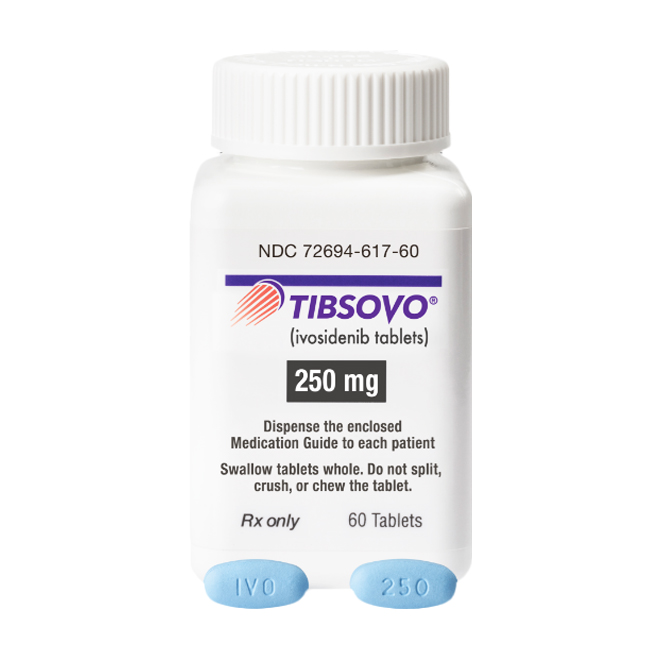


Ivosidenib (Tibsovo) is the first targeted therapy indicated for acute myeloid leukemia (AML) with IDH1 mutations, and its standardized administration is crucial for treatment efficacy.
Dosage, Administration and Recommended Dose of Ivosidenib (Tibsovo)
Confirmation of Eligible Populations
1. Prior to administration, the presence of isocitrate dehydrogenase-1 (IDH1) mutation in the tumor must be confirmed using an FDA-approved testing method.
2. For patients with relapsed or refractory acute myeloid leukemia, the mutation status at the IDH1 R132 locus needs to be verified by laboratory testing.
Standard Dosing Regimen
1. The recommended adult dose is 500 mg orally, once daily.
2. The medication can be taken with or without food.
3. Treatment should continue until disease progression or unacceptable toxicity occurs.
Detailed Administration Instructions
1. wallow the tablet whole; do not chew, crush, or split it.
2. If a dose is missed, do not take a make-up dose; resume the regular dosing schedule at the next scheduled time.
3. If vomiting occurs after taking a dose, no additional dose is needed; maintain the regular dosing interval.
Dose Adjustment of Ivosidenib (Tibsovo)
Differentiation Syndrome
1. Differentiation syndrome can be life-threatening.
2. If symptoms suggestive of differentiation syndrome occur (e.g., fever, dyspnea, hypotension, rapid weight gain, limb edema, etc.), initiate systemic corticosteroid therapy immediately and perform hemodynamic monitoring.
3. Dose interruption: If severe symptoms persist for more than 48 hours despite corticosteroid use, interrupt ivosidenib treatment.
4. Resumption of treatment: Ivosidenib may be resumed when symptoms improve to grade 2 or lower.
For QTc Prolongation
1. Ivosidenib may cause cardiac QTc interval prolongation, increasing the risk of arrhythmias. Electrocardiograms (ECGs) and electrolytes must be monitored regularly before and during treatment.
2. QTc > 480 to 500 milliseconds: Interrupt treatment; restart at 500 mg once daily when QTc returns to ≤ 480 milliseconds, and monitor ECGs at least weekly for the subsequent two weeks.
3. QTc > 500 milliseconds: Interrupt treatment; restart at a reduced dose of 250 mg once daily when QTc returns to within 30 milliseconds of baseline or ≤ 480 milliseconds.
4. Consider re-escalating the dose back to 500 mg once daily after identifying and addressing other causes of QTc prolongation.
5. Permanent discontinuation: Permanently discontinue ivosidenib if QTc prolongation is accompanied by symptoms of life-threatening arrhythmias.
Administration in Special Populations
Patients with Hepatic or Renal Impairment
1. No dose adjustment is required for patients with mild hepatic impairment. Limited data are available for patients with moderate to severe hepatic impairment; use with caution.
2. No dose adjustment is needed for patients with mild renal impairment. No studies have been conducted in patients with severe renal impairment; individualized assessment is recommended.
Reproductive-Age Populations
1. Contraindicated in pregnant women, as the drug has demonstrated clear embryo-fetal toxicity.
2. Effective contraceptive measures must be used during treatment and for at least 1 month after discontinuation of ivosidenib.
3. Lactating women should discontinue breastfeeding or switch to an alternative feeding method.