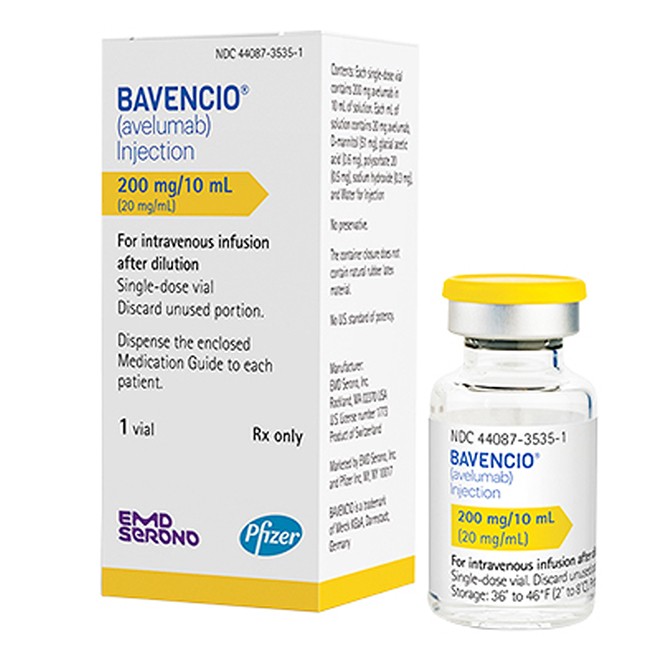


Avelumab (Bavencio) is a programmed death-ligand 1 (PD-L1)-blocking monoclonal antibody approved for the treatment of various solid tumors.
Dosage and Administration, Recommended Dosage of Avelumab (Bavencio)
General Administration Principles
Avelumab must be administered via intravenous infusion, with a standard infusion time of 60 minutes.
To ensure medication safety, premedication with antihistamines and acetaminophen is routinely required before the first 4 infusions. Subsequent premedication should be determined based on clinical assessment and the occurrence of infusion reactions.
Merkel Cell Carcinoma
800 mg every 2 weeks, continued until disease progression or unacceptable toxicity occurs.
Urothelial Carcinoma
First-Line Maintenance Treatment: 800 mg every 2 weeks.
After Prior Treatment Failure: 800 mg every 2 weeks.
Renal Cell Carcinoma
Combination with Axitinib: Avelumab 800 mg every 2 weeks, in conjunction with axitinib 5 mg orally twice daily (12 hours apart), which can be taken with or without food.
Dose Escalation of Axitinib: If the patient tolerates the combination well, gradual escalation of the axitinib dose may be considered after 2 weeks of treatment.
Standardized Infusion Procedures
A comprehensive assessment of the patient’s cardiopulmonary function is recommended before the first infusion, and vital signs should be closely monitored during the infusion.
Infusion-related reactions mostly occur in the early stage of medication; emergency equipment and drugs must be available.
Dose Adjustments for Avelumab (Bavencio)
Management of Organ-Specific Toxicities
Pneumonitis: Withhold treatment for Grade 2; permanently discontinue for Grade 3-4.
Hepatitis:
Without liver tumor involvement: Withhold if ALT/AST > 3-8 × upper limit of normal (ULN); permanently discontinue if > 8 × ULN or bilirubin > 3 × ULN.
Concomitant axitinib treatment: Withhold both drugs if ALT/AST ≥ 3 × ULN and bilirubin ≥ 2 × ULN; sequential rechallenge may be attempted after recovery.
Nephritis: Withhold treatment for Grade 2-3 increased serum creatinine; permanently discontinue for Grade 4.
Skin Reactions: Permanently discontinue if severe reactions such as suspected Stevens-Johnson syndrome occur.
Graded Management of Infusion Reactions
Mild to Moderate (Grade 1-2): Reduce infusion rate or interrupt infusion.
Severe (Grade 3-4): Immediately discontinue infusion and permanently withdraw the drug.
Use in Special Populations for Avelumab (Bavencio)
Patients with Hepatic or Renal Impairment
No dosage adjustment is required for patients with mild to moderate renal impairment (creatinine clearance 15-89 mL/min) or mild to moderate hepatic impairment.
Data on the use of avelumab in patients with end-stage renal disease or severe hepatic impairment are limited; use with caution.
Women of Reproductive Age and Pregnant Women
Contraception Requirements: Women of reproductive age must use highly effective contraceptive measures during treatment and for at least 1 month after the last dose.
Pregnancy Risk: Animal studies have shown that inhibition of the PD-1/PD-L1 pathway may induce fetal immune rejection. Use in pregnant women may cause fetal death; fully inform patients of the risks before medication.
Lactating Women
The drug may be excreted in human milk. It is recommended to suspend breastfeeding during treatment and for at least 1 month after the last dose.