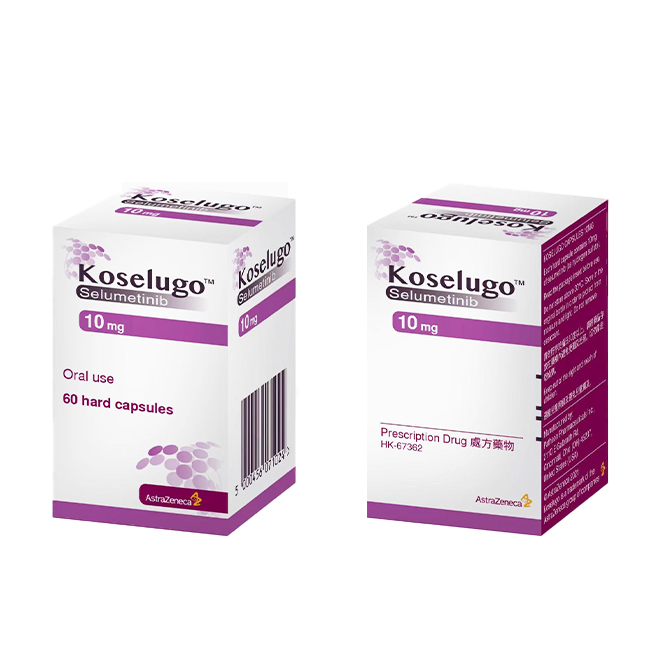


Selumetinib (Koselugo) is a MEK1/2 kinase inhibitor that plays a key role in the treatment of symptomatic, inoperable plexiform neurofibromas (PN) associated with neurofibromatosis type 1 (NF1) in children aged 1 year and older.
How to Use Selumetinib (Koselugo)
Dosage Form Selection and Dosage Regimen
Capsule dosage form: The recommended dose is 25 mg/m², taken orally twice daily. The capsules should be swallowed whole (do not chew, crush, or split them).
Oral granule dosage form: The recommended dose is equivalent to 25 mg/m², taken twice daily. The granules need to be sprinkled on or mixed with soft food before administration.
Capsule Dosage Form
0.55–0.69 m²: 20 mg in the morning and 10 mg in the evening.
0.70–0.89 m²: 20 mg twice daily.
0.90–1.09 m²: 25 mg twice daily.
(The appropriate dose for pediatric patients with a body surface area (BSA) of < 0.55 m² has not been determined.)
Oral Granule Dosage Form
0.40–0.59 m²: 12.5 mg twice daily.
0.60–0.69 m²: 15 mg twice daily.
(The appropriate dose for pediatric patients with a BSA of < 0.40 m² has not been determined.)
Administration Precautions
It can be taken with or without food.
Management of missed doses: If the time to the next scheduled dose is more than 6 hours away, the missed dose can be taken; otherwise, skip the missed dose.
Management of vomiting: Do not take an additional dose to make up for the vomited one; take the next dose as scheduled.
Dosage Adjustment of Selumetinib (Koselugo)
Management of Cardiovascular Toxicity
Asymptomatic left ventricular ejection fraction (LVEF) reduction of ≥ 10% (but still above the lower limit of normal): Suspend administration until recovery, then resume treatment at a reduced dose.
Symptomatic heart failure or grade ≥ 3 LVEF reduction: Discontinue the drug permanently.
Management of Ocular Toxicity
Retinal pigment epithelial detachment (RPED): Suspend administration until recovery, then resume treatment at a reduced dose.
Retinal vein occlusion (RVO): Discontinue the drug permanently.
Management of Gastrointestinal Reactions
Grade 3 diarrhea: Suspend administration until the condition improves to grade 0–1, then resume treatment at the original dose; if no improvement occurs within 3 days, discontinue the drug permanently.
Grade 4 diarrhea or grade 3–4 colitis: Discontinue the drug permanently.
Use in Special Populations for Selumetinib (Koselugo)
Use in Patients with Hepatic Impairment
Moderate hepatic impairment (Child-Pugh B): The recommended dose is adjusted to 20 mg/m² twice daily.
Severe hepatic impairment (Child-Pugh C): The appropriate dose has not been determined.
Dosage Adjustment for Drug Interactions
Avoid concurrent use with strong/moderate CYP3A4 inhibitors or fluconazole.
If concurrent use is unavoidable, reduce the dose of selumetinib to 20 mg/m² twice daily (when the original dose is 25 mg/m²), or make further adjustments as needed.
Special Physiological Status Populations
Pregnancy: Selumetinib has embryofetal toxicity. Effective contraception must be used during treatment and for 1 week after the last dose.
Lactation: Breastfeeding is prohibited during treatment and for 1 week after the last dose.
Elderly patients: Clinical studies did not include patients aged 65 years and older; use with caution.